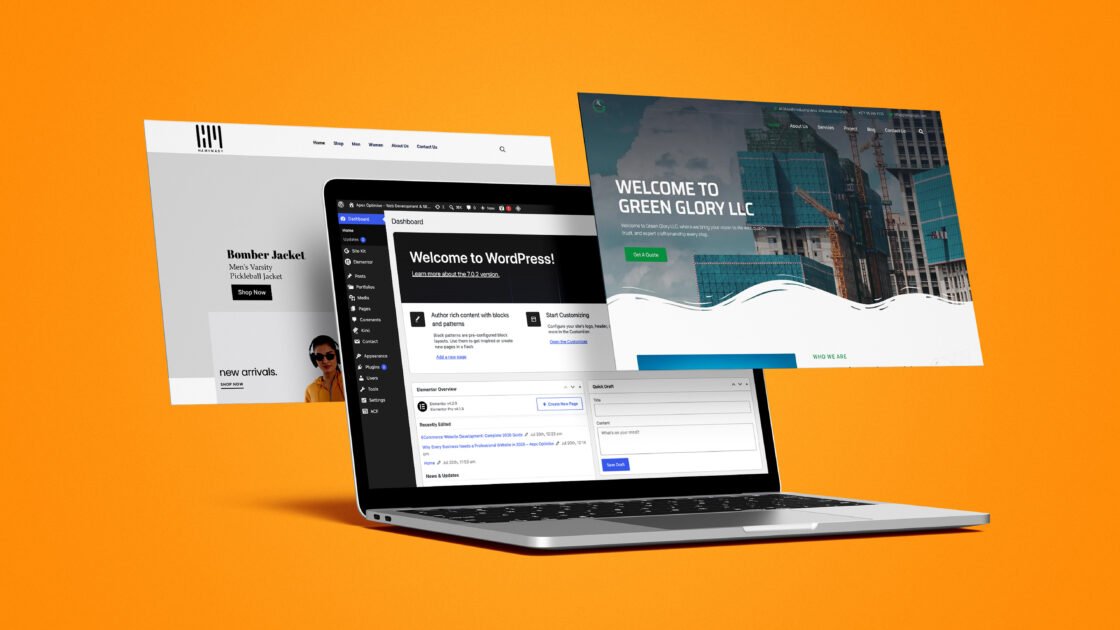


Online shopping is no longer a trend — it is the default way customers buy. From clothing and electronics to groceries and digital services, shoppers now expect every serious business to have a fully functional online store. They want to browse products on their phones, compare prices in seconds, pay securely with their preferred method, and receive their order at their doorstep — all without ever visiting a physical shop.
For business owners, this shift is both an opportunity and a challenge. The opportunity: your potential market is no longer limited to your street, your city, or even your country. The challenge: customers have endless options, and if your online store is slow, confusing, or untrustworthy, they will leave and buy from a competitor within seconds.
That is exactly where professional eCommerce website development comes in. A well-built online store is not just a website with a “Buy Now” button — it is a complete sales system designed to attract visitors, earn their trust, guide them smoothly to checkout, and bring them back for repeat purchases.
In this in-depth guide, we cover everything you need to know about eCommerce website development in 2026: what it involves, the types of online stores, the step-by-step development process, must-have features, platform comparisons, SEO, security, costs, common mistakes, and the latest trends shaping online retail. Whether you are launching your first store or upgrading an existing one, this guide — brought to you by the team at Apex Optimise — will help you make informed decisions at every stage.
The Growth of eCommerce: Why There Has Never Been a Better Time to Sell Online
The rise of online shopping over the past decade has been nothing short of transformational. Three forces came together to make it happen: affordable smartphones put a shop window in every pocket, mobile internet became fast and widely available, and digital payment options matured to the point where paying online became routine rather than risky. The result is a permanent shift in consumer behaviour — browsing, comparing, and buying online is now second nature for a huge share of customers across every age group.
This shift is especially visible in emerging markets like Pakistan. Internet penetration continues to climb year after year, mobile wallets such as JazzCash and Easypaisa have brought digital payments to millions of people who never owned a credit card, and courier networks now deliver reliably to cities and towns across the country. Cash on delivery bridged the trust gap in the early years, and as customers gained confidence, prepaid digital payments have grown steadily alongside it.
Here is what makes this moment a genuine opportunity: while customer demand for online shopping has surged, many local businesses still rely on nothing more than a social media page — or have no online presence at all. That gap is your opening. Businesses that invest in a professional online store today position themselves as the trusted, established option in their niche before the market becomes crowded. In eCommerce, early movers with a serious digital presence do not just win customers — they win the search rankings, the reviews, and the brand recognition that later competitors struggle to catch up with.
The question is no longer whether your customers shop online. It is whether your business is ready to serve them when they do.
What Is eCommerce Website Development?
eCommerce website development is the complete process of planning, designing, building, testing, and optimising a website where customers can browse products or services, add them to a shopping cart, and pay online securely. It combines multiple disciplines into one unified project:
- Web design and branding — creating a visual identity and layout that reflects your brand and builds instant trust with visitors
- Front-end development — building the pages, menus, product grids, and interactive elements your customers see and use
- Back-end development — the engine behind the store: databases, inventory systems, order processing, and admin dashboards
- Payment gateway integration — connecting secure payment methods such as credit/debit cards, digital wallets, bank transfers, and cash on delivery
- Shipping and logistics setup — configuring delivery zones, shipping rates, courier integrations, and order tracking
- Search engine optimisation (SEO) — structuring the store so products and categories can rank on Google and attract free organic traffic
- Security implementation — SSL certificates, data protection, and safe checkout processes that keep customer information secure
The difference between a basic website and a professionally developed eCommerce store is the difference between a brochure and a salesperson. A brochure just displays information; a great online store actively converts visitors into paying customers — 24 hours a day, 7 days a week.
Types of eCommerce Websites
Before development begins, it is important to understand which eCommerce model fits your business, because the model shapes the features your store will need.
B2C (Business to Consumer)
The most common model — a business selling products directly to individual customers. Fashion stores, electronics shops, beauty brands, and grocery delivery services all fall into this category. B2C stores focus on attractive design, fast checkout, and emotional buying triggers such as reviews, offers, and urgency.
B2B (Business to Business)
Businesses selling to other businesses — wholesalers, manufacturers, and suppliers. B2B eCommerce websites often need advanced features such as bulk ordering, tiered pricing, quotation requests, customer-specific catalogues, and credit-based payment terms.
D2C (Direct to Consumer)
Manufacturers and brands selling directly to end customers, cutting out middlemen and marketplaces. D2C stores give brands full control over pricing, customer experience, and — most importantly — customer data, which fuels smarter marketing.
C2C (Consumer to Consumer)
Marketplace platforms where individuals sell to other individuals, such as classified and auction-style websites. These require multi-vendor functionality, seller dashboards, and commission management systems.
A professional eCommerce development company will help you identify your model early, because building a B2C store and later realising you need B2B wholesale features can mean expensive rework.
Why Your Business Needs a Professional eCommerce Website in 2026
Many businesses start by selling through social media pages or third-party marketplaces. That is a fine starting point — but it comes with serious limitations: high commissions, constant algorithm changes, limited branding, and zero ownership of customer data. A dedicated eCommerce website solves all of these problems and unlocks growth that rented platforms simply cannot offer.
1. You Own Your Sales Channel Completely
On a marketplace, you are a guest playing by someone else’s rules. Commission rates can rise, policies can change overnight, and your listings sit right next to your competitors’. On your own online store, there are no marketplace fees eating into your margins, no algorithm deciding who sees your products, and no risk of your account being suspended without warning. Every visitor, every sale, and every customer relationship belongs entirely to you.
2. Professional Websites Build Trust — and Trust Drives Sales
Online shoppers are cautious, and rightly so. Before entering their card details, they look for signals of legitimacy: a secure (HTTPS) website, professional design, clear product information, genuine reviews, transparent return policies, and visible contact details. A polished, secure online store provides all of these signals; a random social media page does not. Trust is the invisible currency of eCommerce — and professional development is how you earn it.
3. Your Store Sells Around the Clock
A physical shop closes in the evening. Your staff go home. Your online store, however, keeps taking orders at midnight, on weekends, and on public holidays. Many store owners are surprised to discover how many orders arrive outside traditional business hours. An eCommerce website effectively gives you a tireless salesperson who never sleeps.
4. Reach Customers Far Beyond Your City
With the right shipping setup, your market expands from your neighbourhood to the entire country — and with international couriers and payment gateways, to the entire world. Businesses in Pakistan, for example, now routinely sell to customers in the UK, USA, and the Middle East through well-built online stores.
5. Lower Operating Costs Than Physical Expansion
Opening a second physical branch means rent, staff, utilities, and inventory duplication. Expanding online means adding products, improving marketing, and scaling your hosting — a fraction of the cost. eCommerce lets small businesses compete with much larger players on a surprisingly level playing field.
6. Data-Driven Decisions Instead of Guesswork
With analytics tools integrated into your store, you can see exactly which products sell best, which pages visitors abandon, where your traffic comes from, and what your average order value is. This data lets you improve continuously based on facts — restocking winners, fixing weak pages, and doubling down on marketing channels that actually work.
7. Personalised Shopping Experiences
Modern eCommerce platforms can show customers products related to their browsing history, recommend complementary items at checkout, and send automated emails for abandoned carts. These personalisation features consistently increase average order values and repeat purchases — and they are only possible on a store you control.
Preparing for Your eCommerce Project: What to Arrange Before Development Begins
The smoothest eCommerce projects are the ones where the business owner comes prepared. Gathering these items before development starts can shave days or even weeks off your timeline — and produces a noticeably better final store.
A domain name. Your web address is part of your brand. Aim for something short, easy to spell, and memorable — ideally a .com, or a country-specific extension like .pk if your focus is purely local. If your exact business name is taken, a development partner can help you find strong alternatives.
A professional business email. An address like orders@yourbrand.com looks far more credible on invoices and order confirmations than a free Gmail account — and it is usually set up alongside your domain.
Brand assets. Your logo, brand colours, and any existing design guidelines. If you do not have professional branding yet, this is worth solving before or alongside development — a store built on weak branding always underperforms. (Apex Optimise’s graphic design team handles logos and brand identity as part of complete store projects.)
Complete product information. Product names, prices, variations (sizes, colours), stock quantities, and the raw details needed to write compelling descriptions. A simple spreadsheet works perfectly. The earlier this is ready, the faster your catalogue goes live.
Product photography. Sharp, well-lit images on clean backgrounds — plus lifestyle shots where relevant. Photography is one of the highest-return investments in eCommerce; customers cannot touch your products, so your photos must do the convincing.
Your policies, decided. How many days for returns? Who pays return shipping? What are your delivery timelines per city? Deciding these upfront means your policy pages — which customers genuinely read — can be written properly instead of copied generically.
Payment accounts. A business bank account, and registrations for the payment methods you plan to accept — card gateway merchant accounts and business wallet accounts for services like JazzCash or Easypaisa. Approvals can take time, so starting early prevents launch delays.
A courier account. If you plan to ship physical products, opening an account with your preferred courier ahead of time allows shipping integration and rate configuration during development rather than after it.
Competitor references. A short list of stores you admire (and ones you find frustrating) gives your design team a fast, clear picture of your taste and your market’s expectations.
None of these are blockers — a good agency will guide you through every item — but arriving prepared turns your development timeline from a marathon into a sprint.
The eCommerce Website Development Process: Step by Step
Understanding the development process helps you plan realistically and communicate effectively with your development team. Here is how a professional agency like Apex Optimise approaches an eCommerce project from start to finish.
Step 1: Discovery and Planning
Every successful store starts with questions, not code. What are you selling? Who is your target customer? Who are your competitors and what do their stores do well or badly? What payment and delivery methods do your customers prefer? The answers shape everything that follows — from platform choice to page structure. This stage also includes defining your product categories, planning the site structure, and setting measurable goals for the store.
Step 2: Choosing the Platform and Technology
Based on your requirements, budget, and growth plans, the development team recommends the right platform — WooCommerce, Shopify, Magento, or a fully custom build. (We compare these options in detail later in this guide.) The wrong platform choice is one of the most expensive mistakes in eCommerce, so this decision deserves careful analysis rather than default habits.
Step 3: UI/UX Design
Design is where your brand comes to life. Wireframes map out the layout of key pages — homepage, category pages, product pages, cart, and checkout — followed by full visual designs with your brand colours, typography, and imagery. Great eCommerce design is not just about looking beautiful; it is about guiding visitors naturally toward purchase with clear navigation, prominent calls to action, and zero confusion.
Step 4: Development and Integration
Developers now build the approved designs into a working store: coding the front end, configuring the back end, setting up product management, and integrating essential third-party services — payment gateways, shipping providers, SMS/email notifications, and analytics tools. Clean, well-structured code at this stage determines how fast, secure, and maintainable your store will be for years to come.
Step 5: Adding Products and Content
Products are uploaded with optimised titles, detailed descriptions, high-quality images, prices, variations (sizes, colours), and stock levels. This stage also includes writing essential pages — About Us, Shipping Policy, Return Policy, Privacy Policy, and Contact — which customers actively check before trusting a new store.
Step 6: Testing and Quality Assurance
Before launch, everything is tested rigorously: placing test orders, processing payments, checking every link, testing on multiple devices and browsers, verifying loading speed, and attempting to break the checkout process in every possible way. Bugs found now cost minutes to fix; bugs found by customers cost sales and reputation.
Step 7: Launch
The store goes live on your domain with SSL security active, analytics tracking configured, and search engines notified through sitemap submission. A smooth launch also includes monitoring the first real orders closely to catch any issues immediately.
Step 8: Post-Launch Maintenance and Growth
Launch is the beginning, not the end. Ongoing maintenance keeps your store secure and updated, while continuous improvements — SEO, marketing campaigns, new features, and conversion optimisation — turn a good store into a great business. This is why choosing a partner that offers ongoing support and maintenance matters as much as the initial build.
eCommerce UX/UI Design Principles That Drive Sales
Visitors judge your store within seconds of landing on it — long before they read a single product description. That snap judgement is driven almost entirely by design. Great eCommerce design is not decoration; it is applied psychology that quietly guides visitors toward purchase. These are the principles that separate stores that convert from stores that merely exist:
Visual hierarchy. The most important elements — your products, prices, and “Add to Cart” buttons — should dominate the page visually. Size, colour, contrast, and placement should lead the eye naturally from product image to price to purchase button, in that order, without the visitor having to think.
Effortless navigation. A customer should reach any product within three clicks of the homepage. Clear category menus, a sticky header that keeps search and cart always visible, and breadcrumb trails (Home > Men > Shoes > Running) keep shoppers oriented instead of lost.
Prominent, consistent calls to action. Buttons like “Add to Cart” and “Buy Now” should use a consistent, high-contrast colour reserved for actions — and appear exactly where the customer’s eye lands after seeing the price. Vague labels kill momentum; action words convert.
Trust signals in the right places. Payment method logos near the checkout button, a visible returns promise on product pages, security badges at payment, and genuine reviews above the fold. Trust elements work hardest at the exact moments customers hesitate.
Breathing room. Cluttered pages feel cheap and overwhelming. Generous white space around products and text makes a store feel premium and makes decisions feel easier — clarity sells.
Consistency across every page. Product cards, fonts, button styles, and image ratios should be uniform throughout the store. Consistency reads as professionalism; inconsistency reads as risk.
Readable typography and accessible contrast. Text should be comfortably readable on a phone in daylight — sufficient size, strong contrast, no decorative fonts for body text. Design that excludes readers excludes buyers.
Designed for thumbs. On mobile, key buttons belong within easy thumb reach, tap targets need adequate size, and forms should trigger the correct keyboards (numeric for phone numbers). Small frictions compound into abandoned carts.
This is why design and development should live under one roof: when the team designing your pages is the same team building them, nothing gets lost in translation between a beautiful mockup and a high-performing live store.
Must-Have Features of a High-Converting Online Store
Not all eCommerce websites are created equal. Two stores can sell identical products, yet one converts five times more visitors into buyers. The difference almost always comes down to these essential features:
- Lightning-fast loading speed — online shoppers are impatient, and every extra second of load time pushes more of them to hit the back button. Speed optimisation — compressed images, quality hosting, clean code, and caching — is a core part of professional eCommerce development, not an optional extra.
- Mobile-first responsive design — the majority of online browsing and buying now happens on smartphones. Your store must not just “work” on mobile; it must feel effortless, with thumb-friendly buttons, readable text, and a checkout that is easy to complete on a small screen.
- Simple, secure checkout — the checkout page is where sales are won or lost. Fewer steps, guest checkout options, clearly displayed costs (no surprise fees at the last step), and multiple payment methods dramatically reduce cart abandonment.
- Multiple payment options — credit and debit cards, digital wallets, bank transfers, and cash on delivery. In markets like Pakistan, offering local options such as JazzCash and Easypaisa alongside cards and COD can significantly widen your customer base.
- Smart product search and filtering — customers should be able to find the right product in seconds using search, categories, and filters for price, size, colour, and brand. If shoppers cannot find it, they cannot buy it.
- High-quality product pages — sharp images from multiple angles, zoom functionality, detailed descriptions, size guides, stock availability, and clear pricing. Product pages should answer every buyer question before it is asked.
- Customer reviews and ratings — social proof is one of the strongest conversion drivers in eCommerce. Genuine reviews reassure hesitant buyers and improve SEO at the same time.
- Wishlist and save-for-later — not everyone buys on the first visit. Wishlists bring customers back and give you insight into product demand.
- Cart abandonment recovery — automated email or WhatsApp reminders for customers who added products but did not complete checkout can recover a meaningful percentage of lost sales.
- Order tracking and notifications — automatic order confirmations, shipping updates, and delivery notifications keep customers informed, reduce “where is my order?” queries, and build loyalty.
- Live chat / WhatsApp integration — instant answers to pre-purchase questions remove hesitation. A simple WhatsApp button can noticeably increase conversions, especially in markets where customers prefer chatting before buying.
- Inventory management — real-time stock tracking prevents the costly embarrassment of selling products you do not have.
- Analytics integration — Google Analytics and Search Console connected from day one, so every decision after launch is based on real data.
- Scalability — your store should handle 100 products today and 10,000 tomorrow, and stay stable when a viral post sends a flood of traffic your way.
Choosing the Right eCommerce Platform
One of the biggest decisions in online store development is the platform your store is built on. Each option has genuine strengths — the right choice depends on your products, budget, technical resources, and growth plans.
WooCommerce
Built on WordPress, WooCommerce powers a huge share of the world’s online stores. It is open-source, highly flexible, and cost-effective.
Best for: Businesses that want full ownership, deep customisation, strong SEO control, and the freedom of the WordPress ecosystem with its thousands of plugins and themes.
Strengths: No monthly platform fees, unlimited customisation, excellent for content marketing and SEO, full control over your data and hosting.
Considerations: You are responsible for hosting, security, and updates — which is why many WooCommerce store owners pair the platform with a maintenance package from their development agency.
Shopify
Shopify is a fully hosted platform known for its polish and ease of use. Hosting, security, and updates are handled for you.
Best for: Businesses that want a reliable, low-maintenance store and are comfortable with monthly subscription fees and transaction charges.
Strengths: Quick setup, dependable performance, large app store, built-in hosting and security.
Considerations: Monthly costs add up over time, customisation has limits compared to open-source platforms, and you operate within Shopify’s ecosystem and rules.
Magento (Adobe Commerce)
Magento is an enterprise-grade platform built for large catalogues and complex requirements.
Best for: Large businesses with thousands of products, multiple stores, multi-currency needs, and dedicated technical budgets.
Strengths: Extremely powerful and scalable, advanced B2B features, granular control over every aspect of the store.
Considerations: Requires significant development expertise and higher budgets — usually overkill for small and medium stores.
Custom eCommerce Development
For businesses with truly unique requirements — complex product configurators, unusual business logic, custom integrations with internal systems, or performance demands beyond standard platforms — a fully custom-built store offers unlimited flexibility.
Best for: Established businesses with specific workflows that off-the-shelf platforms cannot accommodate.
Strengths: Built precisely for your needs, no platform limitations, optimised performance.
Considerations: Higher initial investment and longer development timelines.
Not sure which platform fits your business? The team at Apex Optimise assesses your catalogue size, budget, market, and growth plans before recommending the most cost-effective option — because the right platform is the one that fits your business, not the one that is simply fashionable.
Payment Gateway Integration: Making It Easy to Pay You
A customer who cannot pay the way they prefer is a customer lost at the final step. Professional eCommerce development includes integrating a payment mix suited to your market:
- Card payments — Visa and Mastercard support through trusted gateways is the global baseline for online stores.
- Digital wallets and local methods — in Pakistan, options like JazzCash and Easypaisa reach millions of customers who do not use cards; internationally, wallets like PayPal and Apple Pay serve the same purpose.
- Cash on Delivery (COD) — still a major share of orders in many markets. COD builds trust with first-time customers, and a good development setup manages COD orders, verification, and courier reconciliation smoothly.
- Bank transfers — useful for high-value orders and B2B transactions.
Equally important is how payments are implemented: SSL encryption on every page, PCI-compliant gateways, and a checkout that clearly signals security. Customers should never feel a moment of doubt when entering payment details on your store.
Shipping and Logistics: Delivering on Your Store’s Promise
The sale is not complete when the customer pays — it is complete when the parcel arrives on time, intact, and as described. Delivery is the physical half of your brand experience, and professional eCommerce development sets it up properly from the start.
Courier integration. Modern stores connect directly with courier systems so that when an order comes in, the shipment is booked automatically, a tracking number is generated, and the customer receives it without anyone copying details by hand. In Pakistan, stores commonly integrate with couriers such as TCS, Leopards, Trax, PostEx, and M&P, while international sellers add carriers like DHL and FedEx. Automation here eliminates the manual errors that damage customer trust.
Smart shipping rates. Your development team configures how delivery is charged: flat rates for simplicity, weight-based or city-zone rates for accuracy, and — one of the most effective tactics in eCommerce — a free-shipping threshold (“Free delivery on orders over Rs. 3,000”) that reliably nudges customers to add one more item to qualify.
Cash on delivery, managed properly. COD remains a major payment method in many markets, but it brings operational challenges: order verification to reduce fake orders, and payment reconciliation with couriers. A well-built store includes workflows for confirming COD orders (via SMS or WhatsApp) and tracking which courier payments have been received.
A clear returns pipeline. Returns are part of eCommerce reality. A defined process — how customers request a return, how pickups are arranged, and how refunds or exchanges are issued — turns a potentially negative moment into a trust-building one. Stores with easy, honest returns consistently earn more repeat customers.
Transparent delivery expectations. Displaying realistic delivery timelines on product pages and at checkout (“Delivered in 2–4 working days in Lahore and Karachi”) prevents the single most common post-purchase complaint: where is my order? Paired with automatic tracking notifications, it keeps customers informed and your support inbox quiet.
ECommerce SEO: Getting Your Products Found on Google
A beautiful store is invisible without traffic — and the most valuable traffic is organic: shoppers who find you on Google, ready to buy, without you paying for every click. This is why SEO must be built into your eCommerce website from day one, not patched on afterwards. Professional eCommerce SEO covers several layers:
Keyword Research That Matches Buyer Intent
Effective eCommerce SEO starts by discovering the exact phrases your customers type — not just “shoes” but “men’s running shoes free delivery Lahore”. Product pages target buying keywords; blog content targets research keywords that attract shoppers earlier in their journey.
On-Page Optimisation
Every product and category page needs an optimised title tag, meta description, heading structure, and keyword-rich (but natural) product descriptions. Duplicate manufacturer descriptions — copied across hundreds of competing stores — are one of the most common reasons eCommerce sites fail to rank. Unique content wins.
Technical SEO
Google rewards stores that are fast, mobile-friendly, secure, and easy to crawl. Technical SEO includes clean URL structures, XML sitemaps, proper canonical tags (critical for stores where products appear in multiple categories), fixing broken links, and eliminating crawl errors.
Structured Data (Schema Markup)
Schema markup lets Google display your prices, stock status, and star ratings directly in search results — the rich snippets that make listings stand out and earn dramatically more clicks than plain results.
Category Page Optimisation
Category pages often rank for the most valuable high-intent keywords (“women’s leather handbags”, “gaming laptops under 200,000”). Optimised category titles, intro text, and internal linking turn these pages into powerful traffic magnets.
Content Marketing
Buying guides, comparisons, and how-to articles attract customers who are still researching — and introduce them to your brand before they ever see a competitor. A store with a strong blog consistently outranks and outsells a store without one.
As a combined web development and SEO agency, Apex Optimise builds stores where development and search optimisation work together from the very first line of code — instead of treating SEO as an afterthought that requires expensive rebuilding later.
Speed, Security, and Performance: The Invisible Foundations
Customers rarely compliment a fast, secure website — but they always abandon a slow or suspicious one. Three invisible foundations determine whether your store feels trustworthy:
Speed. Image compression, modern caching, quality hosting, and lean code keep your store loading fast even on average mobile connections. Speed affects everything: bounce rates, conversions, and Google rankings.
Security. An SSL certificate (the padlock in the browser) is mandatory, but real security goes deeper: regular software updates, strong admin protection, secure payment processing, protection against common attacks, and automatic backups so that no technical failure can erase your business.
Reliability. Downtime during a sale or ad campaign burns money and trust simultaneously. Professional hosting, monitoring, and maintenance keep your store online when it matters most — which is always.
This is also the strongest argument for ongoing website maintenance: an unmaintained store gradually becomes slower, more vulnerable, and more likely to break — usually at the worst possible moment.
Conversion Rate Optimisation (CRO): Turning More Visitors into Buyers
Your conversion rate is the percentage of visitors who actually make a purchase — and it is one of the most powerful numbers in your entire business. Here is why: if your store converts 2% of visitors and you improve that to 3%, you have just increased sales by 50% without spending a single extra rupee on traffic. That is the promise of conversion rate optimisation, and it deserves as much attention as bringing visitors in.
Lead with social proof. Humans trust the choices of other humans. Product reviews with photos, visible ratings, “bestseller” tags, and counts like “1,200+ happy customers” answer the silent question every shopper asks: have others bought this and been happy? Stores that showcase genuine proof convert dramatically better than stores that ask for blind trust.
Use honest urgency. Real stock indicators (“Only 3 left”), genuine sale countdowns, and limited-time offers give hesitant shoppers a reason to decide now rather than “later” — which, in eCommerce, usually means never. The key word is honest: fake scarcity destroys trust the moment customers notice it.
Attack cart abandonment. A large share of shoppers add products to their cart and leave without paying. Every abandoned cart is a customer who was inches from buying. Automated recovery emails or WhatsApp messages — “You left something behind, and it’s still available” — recover a meaningful slice of these almost-sales on autopilot.
Strip friction from checkout. Offer guest checkout instead of forced registration. Ask only for information you genuinely need. Show all costs — including delivery — before the final step, because surprise charges at payment are the number one reason carts get abandoned. Enable address autofill and the right mobile keyboards. Every removed obstacle is measurable money.
Place trust where doubt peaks. Doubt spikes at the payment page. That is exactly where security badges, accepted payment logos, and a one-line returns reassurance (“Easy 7-day returns”) belong.
Test instead of guessing. Which headline sells more? Which product photo? Which button text? A/B testing answers these questions with data. Small, continuous experiments compound into large gains over months.
Close the loop with analytics. Your analytics show exactly where visitors drop off — a confusing category page, a slow checkout step, a product page that repels instead of attracts. CRO is simply the discipline of finding those leaks and fixing them, one by one, forever.
A store that is actively optimised does not just get more traffic than its competitors — it earns more from every visitor it already has.
Common eCommerce Development Mistakes to Avoid
After building and reviewing many online stores, certain mistakes appear again and again. Avoid these and you are already ahead of most competitors:
- Choosing the cheapest developer instead of the right one. A poorly built store costs far more in lost sales, security incidents, and rebuilds than a professional build costs upfront.
- Ignoring mobile users. Designing on a desktop and treating mobile as an afterthought — when most of your customers will only ever see the mobile version.
- Complicated checkout. Forcing account creation, hiding delivery charges until the last step, or demanding unnecessary information. Every extra field costs sales.
- No SEO foundation. Launching with duplicate content, missing meta tags, and messy URLs — then wondering why Google sends no traffic.
- Poor product photography and thin descriptions. Online, your images and words are the shopping experience. Weak visuals make even great products look untrustworthy.
- No trust signals. Missing return policies, no contact information, no reviews — the silent killers of first-time purchases.
- Ignoring analytics. Running a store without data is driving blindfolded; you cannot fix what you cannot see.
- No maintenance plan. Treating launch as the finish line, then watching the store slowly break as software ages and security threats evolve.
How Much Does eCommerce Website Development Cost?
There is no single price tag for an online store, because cost depends on scope. The main factors that shape your investment:
- Platform choice — WooCommerce builds typically differ in cost structure from Shopify subscriptions or enterprise Magento projects
- Design complexity — a customised premium theme versus a fully bespoke design
- Number of products — uploading and optimising 30 products is a different job than 3,000
- Features and integrations — payment gateways, courier APIs, multi-currency, multi-language, subscriptions, or custom functionality
- Content creation — product photography, copywriting, and page content
- Ongoing services — hosting, maintenance, SEO, and marketing after launch
The honest answer: a professional store is an investment that should be measured against the revenue it generates, not just its upfront price. A store that costs more but converts twice as well pays for itself quickly. For a realistic quote based on your exact requirements, get in touch with Apex Optimise for a free consultation.
How Long Does eCommerce Website Development Take?
Timelines depend on size and complexity. As a general guide, most standard online stores are completed within 2–6 weeks, covering design, development, product upload, testing, and launch. Larger projects — big catalogues, custom features, or complex integrations — naturally take longer. A clear process with defined milestones keeps your project on schedule, and a good agency will give you a realistic timeline upfront rather than an optimistic guess.
Marketing Your Online Store After Launch: A Complete Traffic Strategy
A brilliant store with no visitors is a showroom in the desert. Launch day is when marketing begins in earnest, and the strongest eCommerce businesses run several channels together — each feeding the others:
SEO — the compounding engine. As covered earlier, search optimisation is the long game that pays forever: rankings earned this year keep delivering free, high-intent visitors for years. It is slower than ads, but it is the only channel where results accumulate instead of stopping the moment you stop paying.
Google Ads and Shopping campaigns. When someone searches “buy leather jacket online”, they are ready to purchase — Google Ads puts your store in front of them at that exact moment. Shopping ads go further, displaying your product image, price, and store name directly in search results, so clicks arrive already half-convinced.
Social media advertising. Meta (Facebook and Instagram) advertising lets you target customers by interests, behaviour, and location with precision — and product catalogue integration means users can browse and tap through to buy without friction. For visual products like fashion, home décor, and beauty, social ads are frequently the highest-volume sales channel.
Organic social content. Reels, styling videos, behind-the-scenes clips, and customer photos build the brand familiarity that makes ads cheaper and conversions easier. People buy from brands they feel they know.
WhatsApp marketing. In markets like Pakistan, WhatsApp is where customers live. A business catalogue, instant pre-sale answers, order confirmations, and tasteful broadcast offers to past customers make WhatsApp one of the highest-converting channels available — personal, immediate, and trusted.
Email marketing. Your email list is the only audience you truly own — no algorithm stands between you and their inbox. A welcome series for new subscribers, abandoned-cart reminders, and well-timed offers to past buyers routinely generate some of the best returns in all of digital marketing.
Retargeting. Most first-time visitors leave without buying — retargeting ads follow up, showing them the exact products they viewed as they browse elsewhere. Because these audiences already know you, retargeting typically delivers outstanding returns on modest budgets.
Influencer partnerships and customer content. Micro-influencers with engaged local audiences can introduce your store with borrowed trust, while reposting real customer photos and reviews supplies endless authentic content that sells harder than any studio shoot.
The real power move is integration: content feeds SEO, SEO feeds traffic, ads amplify what organically works, WhatsApp and email convert and retain. This is precisely why pairing your store with a team that runs digital marketing and SEO under the same roof outperforms juggling disconnected freelancers.
ECommerce Website vs Mobile App vs PWA: What Do You Actually Need?
Business owners often ask whether they need a mobile app alongside — or instead of — a website. The honest answer for most businesses:
Start with a website. A well-built responsive website works flawlessly on every device, requires no downloads, and — critically — is discoverable on Google, where new customers actually find you. One store, one codebase, every customer reached. No app can match that reach.
Add a native app when loyalty justifies it. Apps shine for brands with large bases of frequent repeat buyers: push notifications, saved preferences, and one-tap reordering deepen loyalty. But apps are a significant additional investment, need separate maintenance for iOS and Android, and face a brutal hurdle — convincing customers to download and keep yet another app. For a new store, that budget almost always produces more sales when spent on marketing instead.
Consider a PWA as the middle path. A Progressive Web App is a website with app-like superpowers: customers can add it to their home screen, it loads lightning-fast, and it can send notifications — all without app stores or separate codebases. For many growing stores, a PWA delivers most of an app’s benefits at a fraction of the cost.
The sensible sequence: professional website first, marketing second, and an app only when your repeat-customer data proves it will pay for itself.
Multi-Vendor Marketplace Development
Some entrepreneurs aim bigger than a single store — they want to build the platform where many sellers list products, in the style of a niche marketplace. Multi-vendor development makes that possible, but it is a distinctly more complex project, requiring:
- Vendor onboarding and dashboards — sellers register, upload products, and manage their own orders and stock independently
- Commission management — the platform automatically calculates its percentage on every sale and tracks vendor payouts
- Vendor ratings and accountability — customer reviews per seller keep marketplace quality high
- Order splitting — a single customer cart containing products from three sellers must generate three fulfilments seamlessly
- Dispute and refund handling — clear workflows for when things go wrong between buyer and seller
Marketplaces can be built on WooCommerce with multi-vendor systems or as fully custom platforms, depending on scale and ambition. The economics are attractive — you earn on every transaction without holding inventory — but success depends on solving the classic chicken-and-egg of attracting both sellers and buyers. If a marketplace is your vision, talk it through with our team early: the architectural decisions made on day one determine how far the platform can scale.
ECommerce Trends to Watch in 2026
Online retail evolves fast, and stores built today should be ready for where customers are heading tomorrow:
- AI-powered shopping experiences. Intelligent product recommendations, AI chatbots that answer product questions instantly, and automated personalisation are moving from luxury to expectation.
- Mobile commerce dominance. The shift to mobile keeps accelerating — mobile-first design is no longer a best practice; it is the baseline.
- Social commerce integration. Instagram, TikTok, and Facebook are becoming storefronts themselves. Modern stores integrate product catalogues with social platforms so discovery and purchase connect seamlessly.
- Voice search optimisation. As shoppers increasingly ask their devices instead of typing, stores optimised for natural, conversational search queries gain an edge.
- Augmented reality (AR) previews. Letting customers visualise furniture in their room or try on glasses virtually reduces uncertainty — and returns.
- Faster, more flexible payments. One-click checkout, buy-now-pay-later options, and expanding digital wallet adoption continue to compress the distance between “I want it” and “I bought it”.
- Sustainability signals. A growing segment of customers actively prefers brands that communicate ethical sourcing and eco-friendly packaging.
Building your store on a solid, flexible foundation today means you can adopt these capabilities as they mature — without starting over.
How to Choose the Right eCommerce Development Company
Your development partner will shape your store’s quality, your launch timeline, and your sanity. Here is how to choose well:
Inspect live work, not just screenshots. Ask for links to real stores the agency has built — then actually visit them. Browse on your phone. Check the loading speed. Try the cart. A portfolio of live, functioning stores (like the projects in the Apex Optimise portfolio) tells you infinitely more than a slideshow of mockups.
Prefer full-service over code-only. A developer writes code; a growth partner builds a store designed to rank, convert, and scale. Agencies that combine development with SEO and marketing make hundreds of small decisions correctly during the build — URL structures, page speed, content architecture — that pure coders overlook and that cost heavily to fix later.
Ask the revealing questions. Which platform do you recommend for my business, and why? Who owns the domain, hosting, and website after launch (the only acceptable answer: you do)? Exactly what is included in the quoted price? What happens after launch — is support included, and what does maintenance cost? What is the timeline, with what milestones? Who is responsible for product upload and content?
Watch for red flags. No live examples to show. Vague one-line quotes with no breakdown. Promises of overnight #1 Google rankings (nobody honest promises this). No mention of mobile testing or security. No post-launch support offering. Poor communication during the sales stage — because it only gets worse after payment.
Weigh value, not just price. The cheapest quote is usually the most expensive decision in disguise: slow stores, security holes, and rebuilds cost far more than doing it right once. Judge partners on the revenue their work will generate, not merely the invoice.
Finally, trust the communication test: a partner who listens carefully, explains clearly, and answers questions patiently before you have paid is the partner who will still do so after.
Why Choose Apex Optimise for eCommerce Website Development?
At Apex Optimise, we specialise in building scalable online stores with secure payment integration and conversion-focused design. Businesses choose us because we bring the complete picture together:
- End-to-end service under one roof — web development, SEO, digital marketing, branding, and ongoing maintenance from a single accountable team, so nothing falls between the gaps of multiple vendors.
- Proven, visible results — explore our portfolio of live projects, including eCommerce stores such as Hamy Mady Clothing and NextStile, alongside corporate and travel websites for clients like Meezab Group and Tawaf Global UK.
- SEO built in from day one — as an SEO agency at our core, we build stores that are structured to rank, not just to look good.
- Conversion-focused thinking — every design and development decision is made with one question in mind: does this help turn a visitor into a customer?
- Transparent process and honest timelines — clear milestones, regular updates, and no surprises.
- Ongoing support after launch — maintenance packages that keep your store secure, fast, and up to date, so you can focus on running your business.
ECommerce Website Launch Checklist
Before your store goes live, run through this final checklist — it catches the small oversights that cause big embarrassments:
- SSL certificate active — the padlock shows on every page, and all traffic redirects to HTTPS
- Test order placed and completed — including payment, confirmation email, and (for card payments) a test refund
- All payment methods verified in live mode — not just test mode
- Shipping rates checked — correct charges for different cities, weights, and the free-shipping threshold
- Policy pages published — returns, shipping, privacy, and terms, all customised to your actual business
- Contact details visible — phone, email, WhatsApp button, and physical address if applicable
- Full mobile walkthrough — browse, search, add to cart, and check out entirely on a phone
- Speed tested — key pages load fast on mobile data, not just office Wi-Fi
- Analytics and Search Console connected — tracking confirmed live, sitemap submitted
- Order notification emails firing — for both the customer and your team
- 404 page and redirects configured — no dead ends for visitors or search engines
- Automatic backups scheduled — before launch, not after the first disaster
- Favicon and social sharing previews set — so shared links look professional on WhatsApp and social media
- Stock quantities accurate — the catalogue reflects what you can actually deliver
A professional agency runs this checklist as standard — but as the owner, it pays to know what “launch-ready” really means.
Glossary of Key eCommerce Terms
A quick reference for the terms you will encounter throughout your eCommerce journey:
- Payment Gateway — the secure service that processes online payments between your customer’s bank and yours
- SSL Certificate — the encryption technology behind the browser padlock; mandatory for any store accepting payments
- Conversion Rate — the percentage of visitors who complete a purchase; the core measure of store effectiveness
- Cart Abandonment — when a shopper adds products to the cart but leaves without paying
- SKU (Stock Keeping Unit) — the unique code identifying each product variation for inventory tracking
- AOV (Average Order Value) — the average amount customers spend per order; raising it is often easier than finding new customers
- COD (Cash on Delivery) — payment collected by the courier at the customer’s door
- CMS (Content Management System) — the admin system (such as WordPress) that lets you update your store without coding
- Responsive Design — design that automatically adapts to look perfect on phones, tablets, and desktops
- Schema Markup — code that lets Google show your prices, stock, and star ratings directly in search results
- Organic Traffic — visitors who arrive from unpaid search results; the reward of good SEO
- Retargeting — showing ads to people who previously visited your store
- ROAS (Return on Ad Spend) — revenue generated per unit of advertising cost
- Upselling / Cross-selling — offering a better version of a product, or complementary products, to increase order value
- Chargeback — when a customer disputes a card payment through their bank; minimised by clear policies and good service
Frequently Asked Questions
How much does eCommerce website development cost? Costs vary based on platform, design complexity, number of products, and features such as payment gateways and custom integrations. Contact us for a free, no-obligation quote tailored to your exact requirements.
How long does it take to build an online store? Most standard stores are completed within 2–6 weeks. Larger or more complex projects take longer, and we provide a realistic timeline after understanding your requirements.
Which platform is best — WooCommerce or Shopify? It depends on your business. WooCommerce offers maximum flexibility, ownership, and SEO control; Shopify offers convenience with monthly fees. We recommend the platform that genuinely fits your catalogue, budget, and growth plans.
Can you redesign or fix my existing online store? Yes. We redesign, migrate, speed-optimise, and troubleshoot existing stores — often dramatically improving performance and conversions without a complete rebuild.
Will my online store work on mobile devices? Absolutely. Every store we build is designed mobile-first and tested across phones, tablets, and desktops.
Can you integrate local payment methods and cash on delivery? Yes. We integrate card payments, local wallets such as JazzCash and Easypaisa, bank transfers, and cash on delivery — configured to suit your market.
Do you provide support after the website launches? Yes. We offer maintenance and support packages covering updates, security, backups, and improvements, so your store stays healthy long after launch.
Will my store appear on Google? We build every store with SEO fundamentals in place — clean structure, optimised pages, and proper indexing. For competitive rankings, our dedicated SEO services take your visibility further with ongoing optimisation and content strategy.
Do I need technical knowledge to manage my store after launch? No. We build stores on user-friendly systems and provide training, so you can add products, update prices, manage stock, and process orders through a simple dashboard — no coding required.
Can I start with a smaller store and expand later? Yes, and it is often the smartest approach. We can launch a focused store with your core products and add features — more categories, new payment options, advanced functionality — as your business grows.
What is the difference between a normal website and an eCommerce website? A normal website presents information about your business; an eCommerce website actually sells — with product catalogues, shopping carts, secure payments, inventory management, and order processing built in.
Can you connect my store with courier companies for automatic bookings? Yes. We integrate stores with major couriers so orders are booked automatically and customers receive tracking details without manual work on your side.
Final Thoughts: Your Store Is Your Best Salesperson
Your customers are already shopping online — the only question is whether they are buying from you or from your competitors. A professionally developed eCommerce website gives your business a tireless, trustworthy salesperson that works around the clock: attracting visitors through Google, earning their trust with polished design and security, and converting them with a smooth, friction-free buying experience.
The businesses winning online in 2026 are not necessarily the biggest — they are the ones that treated their online store as a serious investment rather than a checkbox.
Ready to build an online store that actually sells? Get in touch with Apex Optimise today for a free consultation, or email us at info@apexoptimise.com — and let’s turn your products into a thriving online business.